Many, many years ago, during one of my more diligent efforts to learn how to speak and read Korean, I was able to pick up the How to Study Korean lesson pack.

I recall that the lessons were quite helpful and feeling like the format was laid out in a reasonable manner so I have decided to pick up the lessons once more. Unfortunately, I have forgotten much of what I once knew (other than the odd words here and there) so I am going back to the basics with Unit 1, Lesson 1.
If you are interested in following along together, feel free to check out the link using the button above. The entire content for Unit 1 includes Unit 1 PDF, Unit 1 Workbooks, Unit 1 Vocabulary Lists, Unit 1 Audio Packages, Unit 1 Word Search, Unit 1 Conjugation Table and Unit 1 Simple List. It is currently v $40 on sale; I’m not an affiliate or anything so no bias — it’s just the program I’ve decided to use for now.
For the last week or so, I decided not to try moving forward with Lesson One until I felt more confident with the Vocabulary lists we have been reviewing (and caught up on a ton of things at work). Instead I wanted to go back to Unit 0 and go over the Korean Pronunciation for Hangul.
I have actually done quite a bit of independent research into how to improve my pronunciation as I learned how to read the Hangul characters many years ago. I am not however even close to being a professional 😂 Here are some of the tricks I’ve learned in my studies! I will go ahead and use this page as a master page for pronunciation so it may be updated over time.
- The Alphabet in Order (가나다순)
- The Consonants
- The Vowels
- Hangul Writing
- Pronunciation (Basics)
- Consonant Pronunciation
- Consonant Assimilations
- Vowel Pronunciation
- Double Batchim (겹받침)
As always, I am not a fluent speaker of Korean; there are just my own notes while I am learning the language. So if you find errors in this article, please let me know (politely) and I will work on keeping it up to date. Again, this is learning notes not teaching materials. Help is always appreciated! Also if you have any tricks for remembering some of these difficult pronunciation rules (e.g., the assimilations), those are greatly appreciated!
Because I am always coming across new rules, please understand that this post will be frequently changing.
The Alphabet in Order (가나다순)
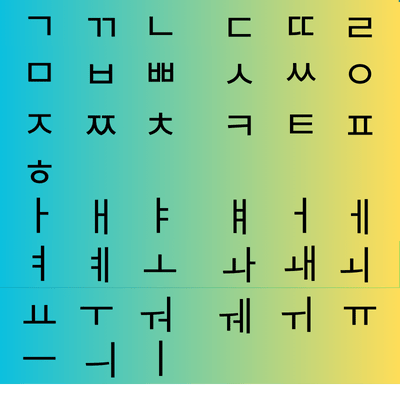
The Consonants
In total, there are 19 consonants in modern Korean in total with ten basic consonants (ㄱ, ㄷ, ㅂ, ㅅ, ㅈ, ㄹ, ㅁ, ㅇ, ㅎ); five tense consonants (ㄲ, ㄸ, ㅃ, ㅆ, ㅉ) and four aspirated consonants (ㅊ, ㅋ, ㅌ, ㅍ). The tend to be written left to right, top to bottom.
Tense consonants (ㄲ, ㄸ, ㅃ, ㅆ, ㅉ) have the word ‘ssang’ meaning ‘double’ before the name of the root letter. For example, ㄲ is a double ㄱ, thus the name ‘ssang giyeok’ or ‘double giyeok’.
Three of the aspirated consonants (ㅋ, ㅌ, ㅊ) are actually just the root consonants (ㄱ, ㄷ, ㅈ) with an additional horizontal line if written traditionally as in the pictures below. It’s a little harder to see with the aspirated ㅍ (based on the root ㅂ) though. I just remember ㅍ as being basically the Greek π (pie) with an additional horizontal line on the bottom since ㅍ sounds like a ‘p’ anyway.
Consonants can change in pronunciation depending on their position within the word (at the beginning or end of a syllable). If coming at the end of a syllable (after the vowel), the consonant(s) is known as a batchim. Pronunciation can also change based on the preceding or succeeding vowels and consonants; more information on this is available in the Consonant Pronunciation and Consonant Assimilation sections below.
The English letters in Table 1 are based on the IPA Pronunciation symbolism.
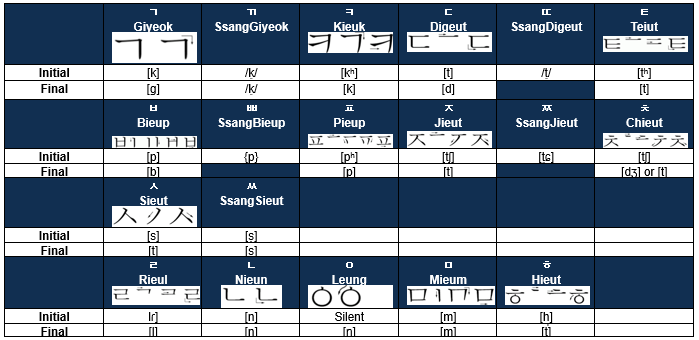
The Vowels
There are eight root vowel sounds;
- ㅏ (ah)
- ㅓ (eo)
- ㅗ (o)
- ㅜ (u)
- ㅡ (eu)
- ㅣ (i)
- ㅐ(ae)
- ㅔ (e)
The rest are new sounds combining two root vowels. Note that with these compound vowels, they are creating a single unified sound like ‘ee’ in ‘meet’ or ‘ui’ in ‘equipment’ in English. You aren’t really pronouncing each vowel separately.
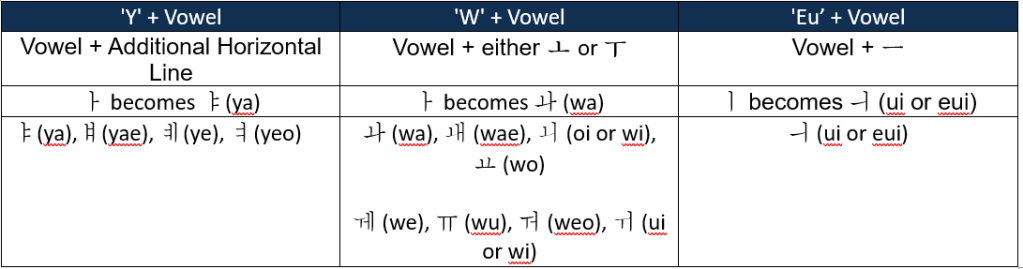
Please note the English letters in this table are Romanized terms.

Hangul Writing
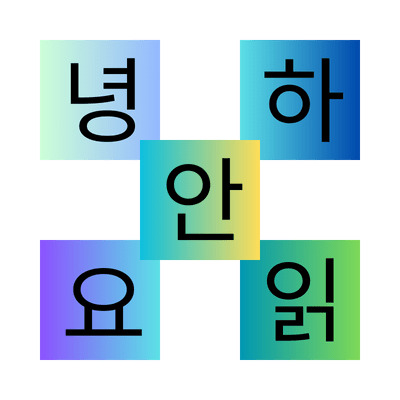
Each syllable in Korean is made up of combination of consonants and vowels. One syllable is written in an imaginary square box with each letter read left to right, top to bottom.

The box above is 녕, a combination of ㄴ (n), ㅕ(yeo), and O (ng). It should be read left to right, top to bottom as ‘nyeong’ and is part of 안녕하세요 or Annyeonghaseyo (Hello).

Here is the full word broken into its separate boxes or syllables — ‘an nyeong ha se yo.’

Within a box, there are four primary ways to produce a single syllable; it depends on whether the vowel is written ‘horizontally’ or ‘vertically.’
Every vowel has a more prominent line that is either horizontal (ㅏ, ㅓ, ㅔ, ㅐ, or ㅣ) or vertical (ㅗ, ㅜ, and ㅡ). You can usually tell just by looking if it is a horizontal or vertical vowel, but if it helps . . . the horizontal vowels are the ‘a, e, i’ variants and the vertical ones are the ‘o, u, eu’ variants.
When the vowel is horizontal, it is written to the right of the first consonant. If the vowel is vertical, it is written below the first consonant. The batchim or final consonant(s) goes below the vowel.
For example, 좋 (Chot) has a vertical vowel (ㅗ) so the syllable has a consonant with the vowel below and a batchim below that. Conversely, 녕 (Nyeong) has a horizontal vowel so the syllable has a consonant with the vowel on the right followed by a batchim below that.
If the vowel is a combination vowel with both a vertical and a horizontal vowel (ㅘ), the vertical is written to the right of the first consonant and the horizontal is written below (same rules as usual). For example, the ㅝ (weo) in 워 (weo) or the ㅘ (wa) in 과 (gwa). The batchim, as always, is written on the bottom as with 환 (hwan).
There are five different syllable combinations that can occur within a single box, each shown in Figure 4. Note that a syllable will always start with a consonant followed by a single vowel.
If the first sound to be pronounced in the syllable is a vowel sound, the first character in the box will be the consonant ㅇ. This consonant is typically silent in a beginning position. For example, 요 (ㅇ +ㅛ ) starts with a consonant in written form, but the ㅇ is silent leaving only the sound of the vowel ㅛ (yo) to be pronounced.
It is possible to just have two characters in a syllable — a consonant + a vowel. An example would be 하 (ha). If there is a final consonant at the end of the syllable (as with 안 or ‘an’), it is known as a batchim as mentioned before. It is possible but rare to have two consonants in the batchim.
Five Possible Combinations (shown up in Figure 4, left to right, top to bottom)
- Spoken Consonant + Vowel + Batchim (녕 – nyeong)
- Spoken Consonant + Vowel (히 – ha)
- Silent ㅇ+ Vowel + Batchim (안 – an)
- Silent ㅇ+ Vowel (요 – yo)
- Consonant or Silent ㅇ + Vowel + Double Batchim (읽 or 찮)
Pronunciation (Basics)
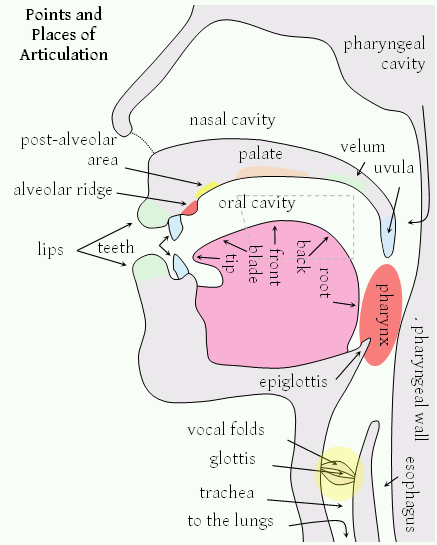
There are millions of resources available trying to explain how to simplify the pronunciation of Korean characters; and it is generally understood that most of the letters do not have a true English translation. They simply are not sounds we commonly use in our own language — they may sound similar but there are little variations that make it difficult for English speakers to master the pronunciation.
I personally believe that the best way to be at least moderately accurate about speaking the language is to understand how the mouth should be physically shaped when a sound is pronounced. This is a more scientific approach and not nearly as easy to study; but I believe in the long run, I understand the differences between similar-sounding letters much more.
With that in mind, I have been using Figure 5 to study each of the letters (consonants and vowels). There is quite a bit of linguistic vocabulary involved, but I will try to keep track of the different terms and definitions as I go along.
Consonant Pronunciation
Consonants are either going to be obstruents (airflow from the throat is limited by various obstructions like the tongue up against the teeth) or as sonorants (airflow has few obstructions if any).
| Term | Definition |
|---|---|
| Obstruents | Airflow up from the throat is limited by various obstructions like the tongue up against the teeth. ㄱ, ㄲ, ㅋ, ㄷ, ㄸ, ㅌ, ㅂ, ㅃ,ㅍ, ㅅ, ㅆ, ㅈ, ㅉ, ㅊ, ㅎ |
| Sonorants | Airflow has few obstructions if any (open mouth, open throat). Think saying ‘ahhhhh’ at the doctor’s office. ㅁ. ㄴ, ㅇ, ㄹ |
Obstruents in Korean are voiceless. Don’t use your throat or larynx to pronounce the letter; instead it is pronounce by pushing air through your mouth or nose in a certain way.
Sonorants are voiced; use your throat or larynx to help pronounce the sound.
| Term | Definition |
|---|---|
| Voiceless | Sounds are pronounced by pushing air through your mouth or nose in a certain way. Does not use your throat or larynx to create the sound. The English ‘s’ in ‘sad’ is voiceless; you just push air between your teeth in a certain way to form the sound. ㄱ, ㄲ, ㅋ, ㄷ, ㄸ, ㅌ, ㅂ, ㅃ,ㅍ, ㅅ, ㅆ, ㅈ, ㅉ, ㅊ, ㅎ |
| Voiced | Sounds are pronounced by pushing air up from your throat and using either the shape or vibrations of the throat / larynx to help create the sound. The English ‘b’ in ‘Baby requires opening up your throat and using your larynx to pronounce the latter part of the ‘b’ — ‘buh‘-aby. ㅁ. ㄴ, ㅇ, ㄹ |
Try saying ‘bay’ and ‘pay’ in English. If pronounced correctly, the ‘b’ in ‘bay’ is pronounced lower and further back in your mouth as the letter finishes. You start with your lips but end at the back of your throat. That is a voiced letter. Conversely, the ‘p’ in ‘pay’ stays up front in your mouth. You never open up your throat. That is a voiceless letter.
This is one of the first places where we see that the English romanizations do not actually match Korean pronunciation. In English, the voiced consonants are b, d, g, l, r, m, n, z, y, and v. In Korean, the only voiced consonants are ㅁ (m), ㄴ(n), ㅇ(ng), and ㄹ(r/l). The rest of the consonants are ‘voiceless‘ including ㅂ (b), ㄷ(d), and ㄱ (g) – romanized as voiced English letters, put actually pronounced as voiceless variants.
Because so many of the Korean consonants are voiceless, the shape of the mouth, tongue, and lips is vital to proper pronunciation. In Table 6, each of the consonants is categorized according to the shape of the mouth (e.g., velar means the back of your tongue should be against the back of the roof of your mouth — see ‘velum’ in Figure 5).
You’ll find an explanation for the additional classifications (e.g., lenis, fortis) in Table 7 further down.
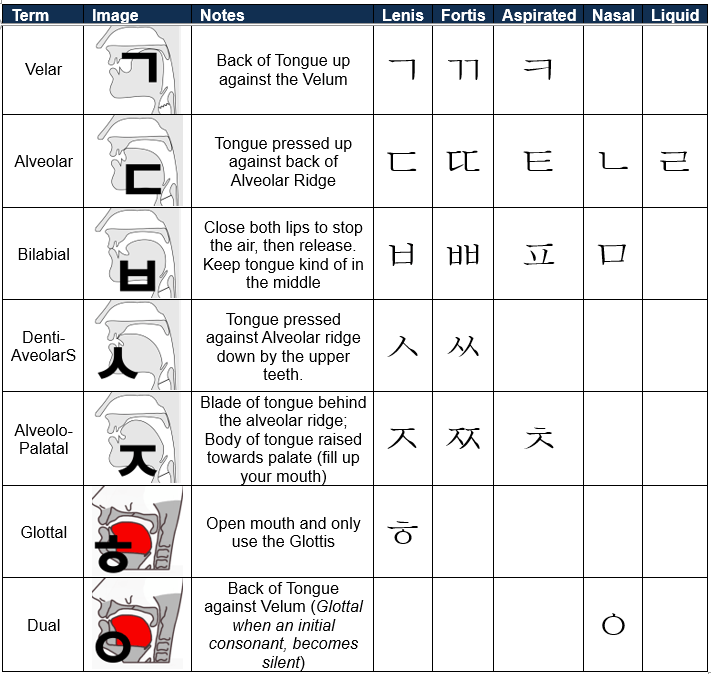
Notice that the shape of the root letters (ㄱ, ㄴ, ㅁ, ㅅ, and ㅇ) is meant to reflect (to some extent) the shape of the mouth when pronounced. For example, when the letter ‘ㄱ’ is pronounced, the tongue come up to press against the back of your mouth before pointing straight towards the front similar to the shape of the letter. The voiced letters (ㅁ and ㅇ) both reflect the shape of the mouth
Below are some additional key terms that are helpful for understanding the linguistic pronunciation of the different letters. Korean consonants are generally classified according to:
- Voiced or Voiceless
- Mouth Shape (e.g., Velar, Alveolar, Bilabial)
- Movement of Air (e.g., Plosive, Fricative, Afficate)
- Tenseness of Throat and/or Tongue (e.g., Lenis, Fortis, Aspirated).
For example: ㄱ is pronounced as a Voiceless Velar Plosive in an initial place and as a Voiced Velar Plosive in a batchim position. A Velar Plosive means start by closing off your mouth by pressing the back of your tongue up against the velum (see Figure 5). Then release the air suddenly. Like the ‘g’ in ‘Gasp’ or the ‘k’ in ‘Kangaroo’ Velar has to do with the position of the tongue and Plosive means stopping up the air then releasing it suddenly. Voiceless and Voiced has to do with whether you carry the sound into your throat.
| Term | Meaning |
|---|---|
| Voiced | Created using vibrations from the vocal cords |
| Voiceless | Created without using vibrations from the vocal cords. |
| Plosive (or Stop) | Vocal tract is completely blocked so that there is no airflow |
| Fricative | Air is forced through a narrow channel. The channel might be made by (1) pressing the lower lip against the top teeth (e.g., the English ‘f’); (2) pressing the back of the tongue against the palate (e.g., the English ‘c’ in ‘capture’); or (3) pressing the side of the tongue against the molars (back teeth) |
| Affricate | Begins as a Plosive (no airflow) but ends as a Fricative (air through a narrow channel). For example, the English ‘ch’ or ‘j’. |
| Nasal | The velum is lowered to allow air to escape through the nose. For example, the English ‘n’ in ‘nose.’ |
| Liquid | ‘R-like sounds’ or ‘L-like sounds’. Built on a Voiced Lateral Approximant (see below). Like the ‘L’ in “Larry’ |
| Lenis (Lax) | “Weak” Consonant – Pronounced with lesser energy like the “b” in “bat”, ‘d’ in “‘dock”, ‘n’ in “nod”, “dd” in “odder” |
| Fortis (Tense) | “Strong” Consonant – Pronounced with greater energy like the ‘p’ in “pat”, ‘t’ in “top”, ‘kn’ in “knot”, ‘tt’ in “otter” |
| Aspirated | Pronounced with a strong burst of breath accompanying the release of or closure of some blockage. The difference between ‘spin’ (unaspirated) and ‘pin’ (aspirated). Typically, voiceless (don’t use the vocal cords). Marked as [kʰ], or (if a particularly long or strong burst) as [kʰʰ}. |
| Sibilant | Pronounced with a ‘hissing’ or ‘hushing’ sound; sort of a drawn out or slightly muffled sound. Like the ‘sh’ in ‘shanty’ or the ‘s’ in ‘salary’. Pronounced at a higher amplitude or pitch |
| Postal-Alveolar | Tongue is near or touching the back of the alveolar ridge. |
| Lateral Approximant | The air flows along one or more sides of the tongue, but the center of the tongue blocks it off from the middle of the mouth. Like the ‘L’ in ‘Lap’ |
There are two possible places for a consonant to appear within a syllable: at the beginning or as a batchim. The sound may vary depending on the location of the consonant or sounds that came before and after. This includes letters from preceding or subsequent ‘boxes’ or syllables.
For example, as a default, the letter ㅎ will be pronounced as an [h] at the beginning of a syllable and as a [t] at the end of a syllable (batchim). However, if the subsequent consonant starting the next syllable box is an ㅁ [m], the ㅎreverts back to an [h] even as the batchim.
The chart below [Table 8] includes the default initial and ending sounds. We will note alterations to this pattern in the Consonant Assimilation section. Instead of using the typical romanizations, we have instead used the IPA symbols which reflect international standards of pronunciation. You can find a lot more information about the IPA system here.
The double consonants (ㄸ, ㅃ, ㅉ) do not appear as a batchim, so they only have an initial sound. While it is possible to have twin consonants as a batchim it only happens with ㄲ (kk) and ㅆ (ss). For example, “있.”
| Consonant | Romanized | Initial | Batchim |
|---|---|---|---|
| ㄱ (Giyeok) | G or K | [k] – Voiceless Velar Plosive | [ɡ] – Voiced Velar Plosive |
ㄲ (SsangGiyeok) | GG or KK | /k͈/ – Voiceless Velar Plosive (Tense) Tense — Stiffen the glottal opening (throat) and tongue / means reiterated articulation (stuttered or repeated rapidly). The tongue does actually form the ‘k’ twice as the air is blown out. Makes it a ‘longer’ sound than the typical [k]. Requires a strong breath so it has strong articulation. | |
| ㅋ (Kieuk) | K | [kʰ] - Aspirated Voiceless Velar Plosive Similar to the ‘Kh’ in “khaki” | [k] – Voicless Velar Plosive |
| ㄷ (Digeut) | D or T | [t] – Voiceless Alveolar Plosive | [d] – Voiced Alveolar Plosive |
| ㄸ (Ssangdigeut) | DD or TT | /t͈/ – Voiceless Alveolar Plosive (Tense) Tense — Stiffen the glottal opening (throat) and tongue / means reiterated articulation (stuttered or repeated rapidly). The tongue does actually form the ‘t’ twice as the air is blown out. Makes it a ‘longer’ sound than the typical [t]. Requires a strong breath so it has strong articulation. | |
| ㅌ (Tieut) | T | [tʰ] – Aspirated Voiceless Alveolar Plosive | [t] – Voiceless Alveolar Plosive |
| ㅂ (Bieup) | B or P | [p] – Voiceless Bilabial Plosive | [b] – Voiced Bilabial Plosive |
| ㅃ (Ssangpieup) | BB or PP | {p͈} – Voiceless Bilabial Plosive (Tense) Tense — Stiffen the glottal opening (throat) and tongue In this case the letter isn’t said twice but the sound is still held longer than the typical [p] due to the stronger breath put into it. It still has has strong articulation. | |
| ㅍ (Pieup) | P | [pʰ] – Aspirated Voiceless Bilabial Plosive | [p] – Voiceless Bilabial Plosive |
| ㅅ (Sieut) | S | Default is [s] – Voiceless Alveolar Fricative Press sides of the tongue along the roof of the mouth but keep it behind the alveolar ridge. Push air through the tongue and upper teeth. Like the ‘s’ in “somebody’ but with your tongue a little further back. Exception: Before the vowels (ㅣ), (ㅟ) , or the ‘y’ and ‘w’ vowels, it sounds like [ɕ] – technically a Voiceless Palatal Fricative said at a higher pitch and amplitude. Use the tongue to guide air towards the teeth. In English, the ‘s’ in ‘sip’ or the ‘sh’ in ‘ship’. Or the ‘t’ in the British ‘Tuesday’ (higher pitched) | [t] – Voiceless Alveolar Plosive Exception: Before the vowels (ㅣ), (ㅟ) , or the ‘y’ and ‘w’ vowels, it sounds like the [ɕ] |
| ㅆ (Ssangsieut) | SS | [s͈] – Sibilant Voiceless Alveolar Fricative (Tense) Tense — Stiffen the glottal opening (throat) and tongue In this case the letter isn’t said twice but the sound is still held longer than the typical [s] due to the stronger breath put into it. It still has has strong articulation. | |
| ㅈ (Jieut) | J | [tʃ] – Voiceless Palato-Alveolar Sibilant Affricate Stop the airflow then guide it with the tongue to the sharp edge of the teeth. Keep the blade of the tongue behind the alveolar ridge and the front of the tongue bunched up at the palate. Direct the air through the center of the tongue rather than to the sides. Similar to the ‘j’ in ‘jack’ but (1) the tongue is further back and (2) air flows along the side of the tongue instead of down the middle. This is why it is often written with a [ch] instead of a [j] | Option 1) If follwed by a vowel [dʒ] – Voiced Postal-Alveolar Fricative. (ʒ) shows that a complete blockage (plosive) of air is released through a narrow channel (fricative). Option 2) if no subsequent vowel [t] – Voiceless Alveolar Plosive |
| ㅉ (Ssangjieut) | JJ | [t͈ɕ] – Alveolo-Palatal Affricate (Tense) Tense — Stiffen the glottal opening (throat) and tongue In this case the letter isn’t said twice but the sound is still held longer than the typical [tʃ] due to the stronger breath put into it. It still has has strong articulation. | |
| ㅊ (Chieut) | CH | [tʃʰ] – Aspirated Voiceless Palato-Alveolar Sibilant Affricate | Option 1) If follwed by a vowel [tʃʰ] – Aspirated Voiceless Palato-Alveolar Sibilant Affricate. Option 2) if no following vowel [t] – Voiceless Alveolar Plosive |
| ㄴ (Nieun) | N | [n] – Voiced Alveolar Nasal | [n] – Voiced Alveolar Nasal |
| ㄹ (Rieul) | R or L | lɾ] – Voiced Alveolar Tip of the tongue makes very brief contact with the back of the alveolar ridge. Air is directed down the middle of the tongue. In English, we curl our tongue up and back to form an ‘r’. In Korean, the tip of their tongue points forward to just briefly touch the alveolar ridge. | [l] – Voiced Alveolar Lateral Approximant Narrow the vocal tract (but don’t completely block the air). Tip of the tongue touches the back of the alveolar ridge. Air is directed down the sides of the tongue rather than the middle. |
| ㅁ (Mieum) | M | [m] – Voiced Bilabial Nasal | [m] – Voiced Bilabial Nasal |
| ㅇ (Leung) | NG | Silent | [ŋ] – Voiced Velar Nasal Constrict airflow in the vocal tract and redirect air through the nose. Keep the back of the tongue at the soft palate and direct air along the middle of the tongue. ‘ng’ as in ‘sing‘ |
| ㅎ (Hieut) | H | [h] – Voiceless Glottal Fricative Sound is produced by the vocal cords by constricting air flow through a narrow channel. Typically formed by pressing the sides of the back of the tongue towards the roof while leaving a hole in the middle. Similar to the ‘h’ in ‘had’ | [t̚] – Voiceless Alveolar Plosive No audible release of air while forming a [t] Exception: If it is followed by a vowel, it still sounds like [h] – Voiceless Glottal Fricative |
There is a reason why so many of the Korean letters appear to shift sounds when in the batchim position.
In English, we follow through on the breath in the final consonant in a syllable. We don’t usually hear it, but often those speaking Asian languages do. It’s why they tend to speak ESL with that extra ‘uh’ sound at the end. It’s very noticeable with colors, like when they say ‘blue + uh’, Notice when we say ‘blue’ in English we start blowing air out with the ‘b’ and continue that through the ‘lue’ until it fades naturally. We actually end up blowing air slightly longer than the word is in our throats, so briefly we never notice it.
In Korean, they don’t have that final follow-through on the breath. As far as I can tell, they form the batchim with their lips but cut off the sound as soon as their lips are in the final position. Try saying ‘drop’ but don’t blow out the ‘p.’ As soon as your lips come together, just stop. You should hear an abrupt ending.
It’s why when they say words like ‘택시’ [Taxi], you know they are pronouncing that final [k] in 택, you can almost hear it, but it just doesn’t sound quite right. Try saying 택시 [taek shi] but as soon as your mouth hits the ‘k’ position just cut it off and move on to the ‘shi’. You’ll get a really abrupt, there but barely there ‘k’ sound.
This ‘abrupt’ ending is for example why ㅅ suddenly sounds like a [d] / [t] sound at the end. Try saying ‘boss‘ but stop as soon as your tongue is in position for the ‘s’. You won’t make the ‘ssss’ sound at all and it sounds a little like a muffled ‘bod’.
Depending on how heavily the letter relies on that final breath of air (e.g., aspirated sounds like ‘p’ or ‘ch’), it can often be hard to hear the final consonant at all.
It is different if the batchim is followed by a syllable starting with a vowel sound. In this case, that final batchim shifts over to start the second syllable and is pronounced in its entirety. Notice however that it now reverts to the sounds used for that consonant in an initial position (e.g., it’s a [k] instead of a [g]). 목요일 [mo kyo il]
Consonant Assimilations
Assimilations are where the letters change in pronunciation based on the preceding or subsequent letters. This is difficult because we more or less just have to memorize the exceptions to the previous default.
This list (based on one from Wikipedia) seems to be a useful resource. The changing sounds are highlighted in yellow.
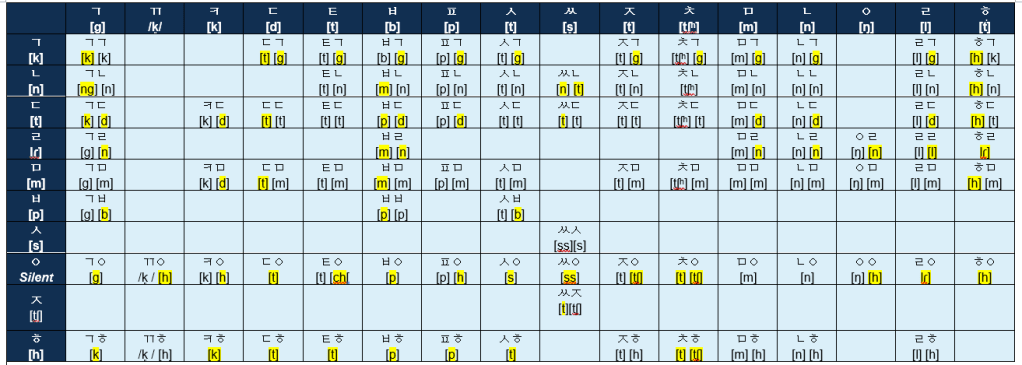
Any other learners getting a strong feeling of (╯°□°)╯︵ ┻━┻ when you hit this section? Jumping Jehoshaphat. . . . more exception than rule
Though helpful, this chart has not always aligned with the rules I’ve been taught. So I’m making a second chart that incorporates rules as I learn them. This chart will be constantly morphing as new rules are added. 😊
These rules come from a whole variety of videos and lessons online. I just stick the rules I find here as a sort of checklist to monitor. If you see an issue with something, please help me out and drop a comment below with the correction!
Part of why consonants assimilate has to do with the complexity that can occur when moving from one sound to another in rapid succession.
Try pronouncing all of the letters in ‘knight’ individually. It would be complicated — especially shifting from ‘k’ to ‘n’ or ‘g’ to ‘h’ directly. It takes a moment for your mouth to shift from one shape to another.
Korean (as with many languages) does not always enunciate every letter’s sound as you flow through a word. For the sake of smoothness, some letters simply go silent and others shift to a similar but easier sound altogether.
This is for example true where the letter ‘ㄹ‘ is concerned; it is often hard to shift rapidly and smoothly from other consonants into an ㄹ position. Consequently, you will often find that when pronounced, the letter ㄹ will often shift to an ㄴ sound instead because that is easier to flow into.
| # | Batchim | Following Initial | The Rule |
|---|---|---|---|
| 3 | Double or Aspirated consonant | _ | The batchim reverts back to the root initial sound without the aspiration. ㅌ [tʰ] is pronounced [t] |
| 4 | ㅅ,ㅈ, ㅎ, ㅆ, ㅊ | _ | The batchim change to [t]. 짓말 [jit mal] [ㅆ, ㅊ] revert to their root initial sounds (see Rule 3); so the same rule applies. |
| 5 | _ | Silent ㅇ | The batchim moves over to replace the ㅇ and reverts to its root initial sound. 싶어 [sa pʰe] |
| 6 | X | X | If both the batchim and the following consonant are the same letter (e.g.,ㄱ followed by ㄱ), the two merge to become a single stronger consonant. 첫사랑 [cheo ssa rang] or 말라요 [ma rra ya] |
| 7 | ㄱ,ㄷ,ㅂ | ㄱ,ㄷ,ㅂ,ㅅ,ㅈ | The second consonant [ㄱ,ㄷ,ㅂ,ㅅ,ㅈ] will be doubled [ㄲ, ㄸ, ㅃ, ㅆ, ㅉ]. 약사 [yak ssa] |
| 8 | ㄱ,ㄷ,ㅂ, ㅈ | ㅎ | The ㅎ drops and changes to an aspirated version of the preceding consonant [ㅋ,ㅌ,ㅍ]. 예약하다 [ye yak kha da] |
| 9 | ㄴ, ㅁ, ㅇ, ㄹ | ㅎ | The batchim moves forward to replace the ㅎ which becomes silent. 열심히 [yeol si mi] |
| 10 | ㄱ,ㄷ,ㅂ | ㅇ, ㄴ, ㅁ | The [ㄱ,ㄷ,ㅂ] become [ㅇ,ㄴ, ㅁ] respectively. 묵을 [mung eul] |
| 11 | ㅊ | ㅁ | The [ㅊ] shifts to an ㄴ |
| 12 | ㄱ,ㄷ,ㅂ,ㅇ,ㅁ | ㄹ | The ㄹ changes to an ㄴ. 심리 [sim ni] |
| 13 | ㄱ, ㅂ | ㄹ | The [ㄱ, ㅂ] change to [ㅇ, ㅁ] respectively |
| 14 | ㄴ ㄹ | ㄹ ㄴ | If ㄴ and ㄹ are side by side (in any order), the ㄴ will become an ㄹ too (just a longer ‘ㄹ’ sound). 문리 [mu rri] |
| 15 | ㅍ | ㄴ | The [ㅍ] will shift to an ㅁ |
| 16 | ㅌ | ㄴ | The [ㅌ] will shift to an ㄴas well. |
| 17 | ㄷ, ㅌ | 이 | The [ㄷ, ㅌ] will change to the root initial sound of ㅈ and shift over to start the new vowel. 굳이[gu ji] – gucci. |
| 18 | ㅎ | Silent ㅇ | The ㅎ also becomes silent. 안 좋아요 [an cho a yo] |
| 19 | ㅎ | ㄱ,ㄷ,ㅂ,ㅈ | The consonants [ㄱ,ㄷ,ㅂ,ㅈ] will become aspirated [ㅋ,ㅌ,ㅍ,ㅊ]. |
| 20 | Double Batchim | Silent ㅇ | Both of the two batchim are spoken. 짧아요 [jjal pa yo] |
| 21 | ㄶ , ㅀ | ㄱ,ㄷ,ㅂ,ㅈ | The [ㄱ,ㄷ,ㅂ,ㅈ] will become aspirated [ㅋ,ㅌ,ㅍ,ㅊ]. |
It is possible for multiple rules to apply all at the same time. She Studies Languages gives the example of 독립. First, apply Rule 8 which says that ㄱ followed by ㄹ results in changing the ㄹ to an ㄴ. This would be 독닙. Then apply Rule 7 which says that when ㄱ is followed by ㄴ, the ㄱ becomes an ㅇ. That means the final pronunciation is 동닙 [dong nib].
I think until you were really familiar with the rules, it may help to get out a checklist of the rules and just run the words against each rule for a few weeks as practice.
There are extra special rules for pronouncing an ㅅ in certain ‘compound words’ (사이시옷) [basically two words are added together to make a new word]. But I haven’t gotten there yet so I’m ignoring this for now. 🤷♀️
Vowel Pronunciation
Korean vowels are typically classified according to:
- The position of the tongue high or low (Open, Close, Near Open)
- The position of the tongue back or forward towards the lips (Back, Central, Front)
- The shape of the lips (rounded, unrounded)
- How the tongue touches the rest of the mount (Palatal, Labial, Approximant)
- Whether the throat / larynx is used to produce the sound (Voiced, Voiceless)
For example,ㅏ[ɐ] is an Unrounded, Near-Open, Central Vowel. This type of vowel requires the tongue to be positioned pretty low in your mouth (way down from the roof of the mouth). It’s not quite ‘on the bottom’ like an Open Vowel would be, but it’s pretty seriously low. Central just means that the tongue is kept in the center of the mouth rather than pulled back towards your throat or forwards towards your lips. Lips are not put in a rounded position. It sound something like the ‘a’ in ‘father.’
| Term | Meaning |
|---|---|
| Open | Tongue is positioned low in the mouth (on the floor of your mouth). This keeps your mouth and throat very open. |
| Near Open | Tongue is positioned pretty low in the mouth, but a little higher than ‘open’ |
| Open-Mid | Tongue is halfway between low in the mouth and mid-way in the mouth. |
| Close-Mid | Tongue is halfway between high in the mouth and mid-way in the mouth. |
| Near Close | Tongue is near the roof of the mouth but not quite to ‘close’ |
| Close | Tongue is close to the roof of the mouth (though not quite touching). This closes off your throat to the airflow. |
| Back | Tongue is towards the back of the mouth |
| Central | Tongue is positions halfway between the front of the mouth and the back of the mouth |
| Front | Tongue is towards the front of the mouth |
| Rounded | Lips are rounded out |
| Unrounded | Lips are not rounded out |
| Raised | Body of the tongue is raised up and back towards the palate |
| Palatal | Blade of the tongue is pressed toward or against the hard palate just behind the alveolar ridge (gums) |
| Labial | The mouth performs one sound while the lips are shaped to modify it (e.g., rounded lips) |
| Labialized Velar | Back of the tongue is raised towards the velum while the lips are rounded |
| Labial-Palatal | Blade of the tongue is pressed towards or against the hard palate just behind the alveolar ridge (gums) while the lips are compressed (like a ‘y’ rather than a rounded ‘u’). |
| Approximant | Slightly narrow (close) your vocal tract but not entirely |
| Voiced | Created using vibrations from the vocal cords |
| Voiceless | Created without using vibrations from the vocal cords. |
Please recall that the combination vowels (e.g., ‘ㅏ’ or ‘ㅘ’) are actually a single combined sound. Something like the English “oa” in boat. You don’t separate the ‘o’ and ‘a’ – it’s a single sound. Or perhaps the ‘wo’ in ‘Two’. The two letters are merging into a single, unique sound.
| Vowel | Romanized | Pronunciation |
|---|---|---|
| ‘Y’ | [j] – Palatal Approximant ‘y’ as in ‘yes’ but get the tongue up towards the roof of your mouth. Don’t close off your throat. Sounds like the German ‘ja’ (yes) to me | |
| ‘W’ | [w] – Labialized Velar Approximant ‘w’ as in ‘watch’ but raise the back of your tongue towards the velum and round out your lips. Don’t close off your throat. Sounds more like the Native American ‘wa’ as in ‘Wapello’ or ‘Wakanda’ to me (Not sure which tribe, just the sound) | |
| ㅏ | a | [a̠] – Open, Central, Unrounded Vowel Similar sounds: ‘a’ in ‘father’ or ‘o’ in ‘lot’ |
| ㅑ | ya | Combination of ‘y’ + ㅏ (a) [ja̠] – combine the ‘y’ sound ([j]) with a Open, Central, Unrounded Vowel [a̠]. ‘Ya’ as in ‘yacht’ or ‘yarn’ |
| ㅘ (wa) | wa | Combination of ‘w’ + ㅏ (a) [wa̠] – combine the ‘w’ sound ([w]) with an Open, Central, Unrounded Vowel [a̠]. ‘W’ as in ‘watch’ |
| ㅐ | ae | Combination ofㅏ (a) + ㅣ(i) /æ/ – Near-Open, Front, Unrounded Vowel or {ɛ} – Open-Mid, Front, Unrounded Vowel Similar to ‘eigh’ as in ‘weigh‘ or ‘pay‘ Listed as a homophone of ㅔ for many speakers — they sound the same in practical speaking. |
| ㅒ | yae | Combination of ㅑ(ya) + ㅣ(i) [jɛ̝] – combine the ‘y’ sound ([j]) with a Raised, Open-Mid, Front, Unrounded Vowel [ɛ̝]. Keep the front of your tongue midway to low in the mouth and the body of your tongue up towards the palate. . Similar to the old English or biblical ‘Ye‘ as in ‘Ye though I walk through the valley of the shadow of death” or like a “yeah”. |
| ㅙ | wae | Combination of ㅗ(o) +ㅐ (ae) [wɛ] – combine the ‘w’ sound ([w]) with an Open-Mid, Front, Unrounded Vowel ([ɛ]) Keep the tongue midway to low in the mouth but towards the front. Similar to a ‘weigh’ or the ‘wai’ in ‘waif’ Mid-way between a long ā (fate) and a short ĕ. |
| ㅓ | eo | [ʌ̹] – More Rounded, Open-Mid, Back, Unrounded Vowel Remember not to round your lips; it is often presented as a short ŏ but your lips should not be rounded like that. Similar to the interrupter ‘uh’. Something like the short ŭ in ‘mud’ or the ‘o’ in ‘wonder’ |
| ㅕ | yeo | Combination of ‘y’ + ㅓ (eo) [jʌ̹] – combine the ‘y’ sound ([j]) with a More Rounded, Open-Mid, Back, Unrounded Vowel ([ʌ̹]). Similar to ‘yu’ in ‘yum’ or ‘young’ |
| ㅝ | weo / wo | Combination of ㅜ (u) +ㅓ (eo) [wʌ̹] – combine the ‘w’ sound ([w]) with a More Rounded, Open-Mid, Back, Unrounded Vowel ([ʌ̹] Similar to the ‘wo’ as in ‘woman’ or ‘won’ |
| ㅔ | e | Combination ofㅓ (eo) + ㅣ(i) [e̞] – Raised, Close-Mid, Front, Unrounded Vowel Keep the front of your tongue midway to high in the mouth and the body of your tongue up towards the palate. Similar to ‘e’ as in ‘eggs’ or the ‘eigh’ in ‘weigh‘ Listed as a homophone of ㅐ for many speakers — they sound the same in practical speaking. |
| ㅖ | ye | Combination of ‘y’ + ㅔ (e) [je̞] – combine the ‘y’ sound ([j]) with a Raised, Close-Mid, Front, Unrounded Vowel [e̞]. Keep the front of your tongue midway to high in the mouth and the body of your tongue up towards the palate. Similar in sound to the old English or biblical ‘Ye‘ as in ‘Ye though I walk through the valley of the shadow of death” or like a “yeah”. |
| ㅞ | we | Combination of ㅜ (u) +ㅔ (e) [we̞] – combine the ‘w’ sound ([w]) with a Raised, Close-Mid, Front, Unrounded Vowel [e̞]. Keep the front of your tongue midway to high in the mouth and the body of your tongue up towards the palate. Similar to a ‘weigh’ or the ‘wai’ in ‘wait’ Mid-way between a long ā (fate) and a short ĕ. |
| ㅗ | o | [o̞] – Raised, Close-Mid, Back, Rounded Vowel Not quite a long ō sound. More like the ‘o’ in ‘gold’; a little more muffled because your tongue is mid to high in the back of your mouth. |
| ㅛ | yo | Combination of ‘y’ + ㅗ (o) [jo] – combine the ‘y’ sound ([j]) with a Raised, Close-Mid, Back, Rounded Vowel [o̞]. Similar to the ‘yo’ in ‘yodel’ or ‘yogurt) |
| ㅜ | u | [u] – Close, Back, Rounded Vowel Similar to a long ū in ‘nude’ or a double o͞o as with food. |
| ㅠ | yu | Combination of ‘y’ + ㅜ (u) [ju] – combine the ‘y’ sound ([j]) with a Close-Back, Rounded Vowel [u] Similar to ‘you‘ or the ‘u’ sound in ‘unicorn’ |
| ㅡ | eu | [ɯ] – Close, Back, Unrounded Vowel Kind of a cross between a short double oo sound as in ‘rook’ and the short ŭ in ‘pudding’. Sounds to me kind of like when you get punched in the stomach but softer . . . ‘ooh’ |
| ㅣ | i | [i] – Near- Close, Front, Unrounded Vowel Similar to the Spanish ‘i’ as in ‘Si‘ (yes) or the double ee in ‘bee‘ |
| ㅚ | oi or oe | Combination of ㅗ (o) + ㅣ(i) [we̞] – combine the ‘w’ sound ([w]) with a Raised, Close-Mid Front Unrounded Vowel [e̞]. or [ø̞] – a Close-Mid Front Rounded Vowel Quite similar to the sound of ‘way‘ and bit it seems like usually you don’t round your lips. Also similar to the ‘we’ of ‘wedding’ |
| ㅟ | ui or wui | Combination of ㅜ (u) +ㅣ(i) [y] – Close, Front, Rounded Vowel (like the German ü) or [ɥi] – combine [ɥ] with [i]. [ɥ] is a Voiced Labial-Palatal Approximant (uses the throat (voiced) but narrows the throat so the air passing through is thinner (approximant). Blade of the tongue is pressed up behind the alveolar ridge while lips are compressed (like a ‘y’ rather than a rounded ‘u’). Then it ends with the [i] which is a Close, Front, Unrounded Vowel. Similar to the double ee sound in ‘week’ or the ‘wi’ in ‘wings’ |
| ㅢ | eui or ui | Combination of ㅡ (eu) +ㅣ(i) {ɰi] – Combine a [ɰ] (Close Back Unrounded Vowel) with an [i] Close Front Unrounded Vowel Pronunciation can change depending on its location within a word. (1) If in the first syllable + syllable starts with ㅇ, the pronunciation is the regular ㅢ (2) If in the first syllable + syllable starts with a consonant OR if not in the first syllable, the pronunciation may be ㅣ[i] (3) If used to denote possession of something (e.g., his, mine), the pronunciation may be ㅔ Sounds like it starts with a long oo and ends in the long ee sound. Like the ooey in ‘gooey‘ or ‘phooey‘ |
Double Batchim (겹받침)
As we mentioned before, occasionally two consonants appear side by side in the final position of a syllable. While the use of these double batchim in words is unusual; those few words can reappear frequently in the language as common vocabulary.
There are eleven possible combinations of double batchim. Although these jamo (letters) appear to complicated, the rules are relatively straightforward. Typically, you only pronounce one of the two consonants with the current syllable. These batchim are thus classified according to which of the two consonants is actually pronounced.
| Pronounced Consonant | Double Batchim |
|---|---|
| ㄳ, ㄵ, ㄶ, ㄼ, ㄽ, ㄾ, ㅀ, ㅄ | First Consonant |
| ㄺ, ㄻ, ㄿ | Second Consonant |
For example, in the double batchim “ㄳ”, the consonant sound to be spoken is the ㄱ [k].
One exception to this rule is if the following syllable begins with the Silent ㅇ + vowel. In this case, (1) the first consonant is spoken with the first syllable and (2) the second consonant shifts to the next syllable and replaces the ㅇ. Assume the first syllable ends with ㄵ and the next one starts with Silent ㅇ + vowel. You pronounce the ㄴ with the first syllable. Then move the ㅈ over to start the next syllable attached to the vowel.
The easiest way to learn these is to focus on the minority grouping (ㄺ, ㄻ, ㄿ) where the second consonant is spoken; then just remember that the rest use the first consonant.
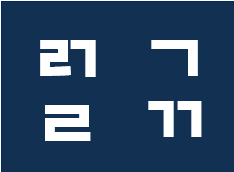
A second exception that needs to be noted: Assume one syllable ends with ㄺ and the next syllable starts with ㄱ. In this unique situation, pronounce the ㄹ at the end of the first syllable and then shift the (ㄱ) over to join the other ㄱ at the beginning of the second syllable to create a ssanggiyeot (ㄲ). This is only true for this particular combination.
Disclaimer
This website is absolutely not a professional resource and is purely my own personal way of trying to learn various languages. If you see a mistake, by all means please let me know in the comments as long as you do so in a friendly way. ❤️
 Where Dragons Roam
Leave a comment