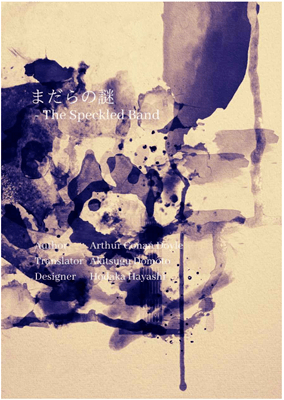
As a passionate mystery enthusiast, I have purchased a copy of Arthur Conan Doyle’s “The Speckled Band” as translated into Japanese by Akitsugu Domoto (Link). I am working through a side-by-side translation back into English as a way to study Japanese, using a free online copy of the original source (Link). My dream would be to have sufficient Japanese fluency someday to read some of the Japanese detective novels like those by Keigo Higashino in their original language; particularly those for which there is no present English translation.’
Feel free to learn alongside me!
Original Text: In glancing over my notes of the seventy-odd cases in which I have during the last eight years studied the methods of my friend Sherlock Holmes, I find many tragic, some comic, a large number merely strange, but none commonplace; for, working as he did rather for the love of his art than for the acquirement of wealth, he refused to associate himself with any investigation which did not tend towards the unusual, and even the fantastic.
Arthur Conan Doyle, “The Speckled Band”, Link.
Note 1: I noticed that the Japanese translation breaks this long sentence into four separate sentences. One sentence is a lot for me, so here is part one!
Note 2: I alternated between red and black to show separate words / parts of speech.
Translation (for study):
七十 件 にも 上る 奇異 な 事件 簿 を 眺め ながら、 この 八 年、 友人 で ある シャーロック・ホームズ が いかに し て 事件 を 解決 し て き た か について、 この 私、 ワトソン は 研究 し て き た。
| Glancing over the records of as many as seventy strange cases, | |||||||
| Seventy | cases, matters, records | also | up to / as many as | strange, odd | 事件event, incident ‘cases’ + 簿 record book | *marks object of a verb, after noun | to view, to gaze at |
| nana jū | ken | ni mo | noboru | kina | jikenbo | o | nagamenagara |
| 七十1 | 件 | にも | 上る | 奇異 な | 事件 簿 | を | 眺め ながら |
| these eight years | ||
| this, these | eight | years |
| kono | hachi | nen |
| この | 八2 | 年 |
| about how my friend, Sherlock Holmes, resolved the events | |||||
| friend | Sherlock | Holmes | *marks the subject of a sentence | how, in what way, the methods by which | to do, to cause |
| yūjindearu | shārokku | hōmuzu | ga | ikani | shite |
| 友人 で ある | シャーロック | ホームズ | が | いかに | し て |
| Event, incident, ‘cases’ | *marks object of a verb, after noun | resolution | to continue doing something | *marks an unknown (a question, either . . . or) | about |
| jiken | o | kaiketsu | shitekita | ka | nitsuite |
| 事件 | を | 解決 | し て き た | か | について |
| I, Watson, | ||
| this | I, me | Watson |
| kono | Watashi | watoson |
| この | 私 | ワトソン |
| Am studying | |||
| *marks the topic or theme of the sentence | study, research | to continue doing something | |
| wa | kenkyū | shitekita3 | |
| は | 研究 | し て き た | |
- Seven can also be pronounced as “shichi” in the on’yomi reading, but in this case it is part of a standalone (70) and uses the kun’yomi “nana”. Otherwise, I know ’70’ from months ↩︎
- I know this character from doing the months ↩︎
- It appears that by adding ‘kita’ to shite, it suggests that the verb is continuing. ↩︎
With this sentence, I have learned to following particles / grammatical notes:
| Japanese | Romanized | English |
|---|---|---|
| を | o | Particle Follows the direct object of a verb |
| か | ka | Particle Complicated, generally denotes a question (?) or an unknown (e.g., either / or) |
| が | ga | Particle Follows the subject of the sentence |
| は | wa | Particle Points to the main topic or theme of the sentence |

Terms that repeated more than once:
| Japanese | Romanized | English |
|---|---|---|
| 事件 | jiken | event, incident, cases |
| し て | shite | to do or to cause something to occur |
| し て き た | shitekite | to continue (kite) + to do or cause something to occur (shite) |
| この | kono | this, these denotes something nearby |
Disclaimer
This website is absolutely not a professional resource and is purely my own personal way of trying to learn various languages. If you see a mistake, by all means please let me know in the comments as long as you do so in a friendly way. ❤️
 Where Dragons Roam
Leave a comment